
Toyama Sake Guide: Mountain Water, Toyama Bay, and a Culture Built Around Umami

Toyama is not usually the first place international drinkers think of when they hear the word sake.
Kyoto may come to mind.
Niigata may be familiar to more serious sake drinkers.
And some people may know neighboring Ishikawa because of Kanazawa.
Toyama often sits quietly between them.
That changed for us after our latest Weekly Sake Flight.
We tasted six very different sake from Toyama Prefecture, paired them with local seafood and kelp-based foods, and explored what connects the region’s mountains, water, rice, and drinking culture.
Our biggest takeaway was simple:
Toyama sake has much more range than we expected.
Some bottles were clean and refined.
Others had obvious rice flavor and weight.
One was an unfiltered, unpasteurized, undiluted sake with a bold personality.
Another was relatively low in alcohol and felt almost designed for a wine-drinking audience.
And one had actually been aged inside the Kurobe Dam.
To understand why all of this makes sense in one prefecture, we first need to understand where Toyama is.
1. First, Where Is Toyama?
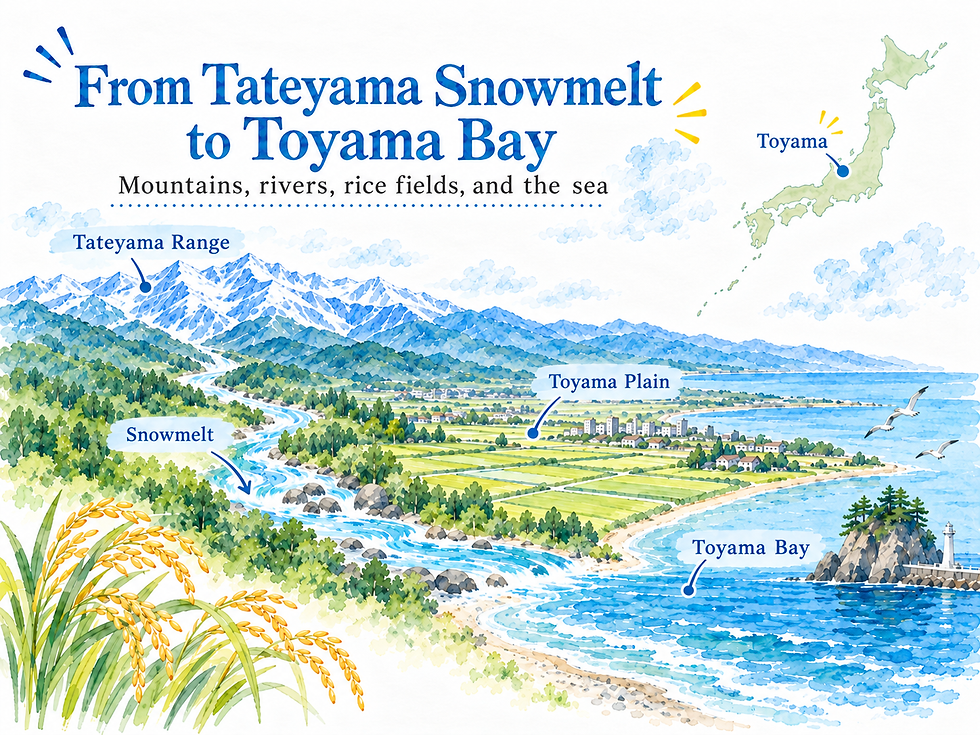
Toyama Prefecture is on the Sea of Japan coast in central Honshu, Japan’s largest island. It sits between Niigata Prefecture to the east and Ishikawa Prefecture to the west.
To the south and southeast rise the Japanese Alps, including the dramatic Tateyama mountain range, where peaks reach around 3,000 meters.
To the north is Toyama Bay.
The distance between the mountains and the sea is remarkably short.
Toyama Bay reaches depths of more than 1,000 meters, while 3,000-meter mountains rise behind it. Within roughly 50 kilometers, the landscape changes by around 4,000 meters in elevation.
That geography is one of the keys to understanding Toyama.
Snow falls on the mountains.
Snowmelt becomes rivers and underground water.
The water reaches the plains, where rice is grown.
The rivers and underground water eventually reach Toyama Bay.
So the regional story flows naturally:
mountains → water → rice → sake → seafood
In few places in Japan is that connection so easy to see.
2. Why Water Matters in Sake
If you are new to sake, it helps to remember that water is not a minor ingredient. The finished drink is mostly water, and breweries also use large amounts of it throughout production.
Toyama is particularly proud of its water.
According to Toyama Prefecture, the average hardness of its river water is around 31.2 mg/L. That places it on the softer side. Soft water is common in Japan, and historically brewers learned to adapt their fermentation methods to their local water.
But we should avoid an overly simple conclusion such as:
“Soft water automatically makes light sake.”
It does not.
Different breweries use different wells, springs, and water sources. Rice, yeast, koji, fermentation temperature, aging, and many other decisions also shape the final drink.
Water is one part of the story. Still, when we tasted several Toyama sake side by side, a sense of clarity and balance appeared repeatedly.
The water story helps provide context for that impression.
3. Toyama Between Niigata and Ishikawa

One of our most interesting impressions from the tasting was that Toyama seemed to sit somewhere between its two famous sake neighbors.
This is not a rule.
Sake regions are far too diverse to reduce to one flavor. But as a learning tool, the comparison was useful.
Niigata is widely associated with sake that feels light, clean, and sharply finished. Ishikawa often shows another side of Hokuriku sake culture, with more savory flavor, texture, and umami. Several Toyama bottles seemed to find a balance between those two directions.
Then we discovered an interesting historical connection.
Toyama’s official regional food guide explains that local breweries historically worked with both Echigo Toji and Noto Toji.
A toji is the traditional head brewer responsible for leading a sake-brewing team.
Echigo Toji came mainly from neighboring Niigata and became associated with clean, crisp brewing styles. Noto Toji came from the Noto Peninsula in Ishikawa and became known for richer, more full-flavored sake. That does not mean modern Toyama sake is simply a 50/50 mixture of the two.
Many breweries today have their own permanent brewing teams and philosophies. But the history makes our tasting impression much more interesting. Toyama has literally spent generations between two influential brewing cultures.
4. Toyama Developed Its Own Sake Rice

For international drinkers, one important piece of sake vocabulary is sake rice.
Japanese people eat rice every day, but breweries can also use rice varieties developed specifically for brewing. These varieties are often larger and may have internal characteristics that make them easier to polish and ferment.
Toyama has developed two of its own important brewing rice varieties:
Oyama Nishiki
and
Tomi no Kaori.
Oyama Nishiki was developed in Toyama in 1999. Tomi no Kaori followed in 2008.
The story of Tomi no Kaori is particularly interesting. Yamada Nishiki is one of Japan’s most prestigious sake rice varieties, but it is relatively late-ripening and can be difficult to cultivate reliably in Toyama’s climate. Researchers therefore worked to create a rice with strong brewing qualities that was better suited to local conditions.
Tomi no Kaori was developed from Yamada Nishiki and Toyama’s own Oyama Nishiki. In other words, Toyama’s sake identity is not only based on using local water. The prefecture has also invested in creating rice specifically for its own environment. That is a useful reminder that regional sake culture is not frozen in history. It continues to evolve through agriculture and research.
5. Toyama Bay: Japan’s “Natural Fish Tank”

Toyama sake becomes much easier to understand when you look at the food. Toyama Bay is often described in Japan as a “natural fish tank.”
It is extremely deep and sits directly below the mountains. Nutrient-rich water flows from the forests and mountains into the bay, while deep, cold water from the Sea of Japan creates another marine environment below.
The result is an unusually rich seafood ecosystem.
Toyama is particularly associated with:
white shrimp,
firefly squid,
yellowtail,
shellfish,
and many other kinds of seafood.
For a beginner, you do not need to memorize those names.
The important idea is: Toyama is a seafood region.
That matters because sake here is often experienced at the table rather than by itself.
A clean sake can refresh the palate after seafood.
A more savory sake can echo the umami in fish.
A stronger sake can stand up to more intensely seasoned dishes.
Regional sake makes more sense when regional food enters the picture.
6. Why Is Toyama Obsessed With Kombu?

There is another food that helps explain Toyama:
kombu, or edible kelp.
This creates an interesting paradox. Toyama is not a major kombu-producing region. Most Japanese kombu comes from Hokkaido, far to the north. Yet Toyama has historically ranked among Japan’s biggest kombu-consuming areas. Why?
The answer is trade.
During the Edo and Meiji periods, merchant ships known as **Kitamaebune** traveled along the Sea of Japan, connecting Hokkaido with ports further south. Kombu from Hokkaido traveled along this route. Toyama became deeply connected to that trade network, and kombu gradually became part of everyday local food culture.
One of the clearest examples is kombu-jime. Fresh fish is placed between sheets of kombu. The kelp contributes umami while the fish develops a denser, more concentrated flavor. For anyone learning sake pairing, this is extremely useful.
You are not simply pairing alcohol with raw fish.
You are combining:
fish umami,
kombu umami,
salt,
texture,
and sake.
That is why Toyama is such a good region for understanding the Japanese idea of pairing through umami rather than simply matching intensity.
7. The Six Sake We Tasted
At our Weekly Sake Flight, we tasted six bottles that showed very different sides of Toyama.

Haneya Tokubetsu Junmai
Haneya is probably one of the Toyama labels international sake drinkers are most likely to encounter outside the prefecture. The Tokubetsu Junmai showed a modern side of Toyama: clean, fresh, balanced, with enough acidity and umami to work comfortably with food.
For beginners, it was an easy reference point before moving into more unusual styles.
Sanshoraku Hiyaoroshi Junmai
Sanshoraku is based in the mountainous Gokayama area. The bottle we tasted was *hiyaoroshi*, a seasonal autumn sake.Traditionally, sake brewed in winter is pasteurized in spring, rested through summer, and released around autumn after some maturation.
This bottle was also 18% alcohol, giving it considerably more weight than the Haneya.
That contrast immediately showed why one prefecture should never be reduced to one sake style.
Yoshinotomo Jun
Yoshinotomo Shuzo was founded in 1877 and focuses on junmai sake.
Junmai means sake made from rice, koji rice, water, and yeast without the addition of distilled brewing alcohol. Yoshinotomo was one of the bottles we personally enjoyed most during the tasting. Rather than relying only on dramatic aroma, it made sense at the table, where rice flavor, acidity, and food could interact.
That food-friendly quality fits Toyama particularly well.
Kaze no Bon Junmai Ginjo — Kurobe Dam Aged
This bottle had the most unusual story of the session.
It had been aged inside the Kurobe Dam.
Yes — an actual dam.
More on that shortly.
Bikyu Tokubetsu Junmai Muroka Nama Genshu
This became one of the participant favorites. The terminology sounds intimidating, but each word tells us something.
Muroka means it was not charcoal-filtered in the usual way.
Nama means unpasteurized.
Genshu means it was not diluted down with additional water after fermentation.
The result was a much bolder expression than the stereotypical image of delicate Japanese sake. There was clear weight, acidity, rice character, and intensity. For some beginners, that difference made it easier — not harder — to understand sake.
BianCozy Junmai
Then came something very different again.
BianCozy from Uozu Shuzo was only around 13% alcohol, relatively low for sake.
It felt lighter and more casual than many traditional bottles in the flight.
This kind of sake can make a particularly good bridge for wine drinkers who find conventional sake unfamiliar.
By the time we reached the sixth bottle, the idea of one “Toyama style” had completely fallen apart.
And that was probably the most useful lesson.
8. Why the Boldest Sake Became a Favorite
One of the clearest observations from the event was that Bikyu was particularly popular.
That challenged a common assumption about sake education.
When introducing beginners to sake, it is tempting to start only with something light, clean, and easy.
But “easy” is not always the same as “interesting.”
Bikyu was distinctive.
You could immediately taste that it was different.
That can actually help beginners.
If six drinks show only tiny variations, someone without much tasting experience may struggle to understand what they are supposed to notice.
A bottle with obvious personality gives them a reference point.
This is something we have increasingly noticed at Weekly Sake Flight:
Beginners do not always need the safest sake. Sometimes they need the most memorable one.
9. What Is Dam-Aged Sake?

Now back to the Kurobe Dam. Toyama started the Toyama Dam-Aged Sake Project in 2020.
The concept is unusual but logical.
The interior of a dam is:
dark,
cool,
and relatively stable in temperature.
Those conditions make it an interesting place for slow sake maturation. For one Kurobe Dam project, sake from 14 Toyama breweries — more than 16,000 bottles — was placed inside the dam beginning in 2022. The bottles remained there for roughly a year and a half before being removed in 2024.
Our Kaze no Bon was part of this broader dam-aging story. Whether or not dam aging becomes a major sake category is almost beside the point. What makes the project interesting is how strongly it connects a drink with place.
Toyama took one of its most famous pieces of infrastructure and turned it into a sake cellar.
Mountains.
Water.
Hydroelectric power.
A dam.
Sake.
Few drinking stories could feel more specifically Toyama.
10. The Food We Ate With the Sake

The snacks at the tasting were deliberately simple.
We had Toyama-inspired foods including:
dried firefly squid,
trout and kombu-based preserved food,
red fish cake,
and fish cake wrapped in kombu.
Fish cake, or kamaboko, is another ingredient international visitors may need explained.
It is made from seasoned fish paste that is shaped and cooked into a firm but tender texture.
Toyama has distinctive styles, including decorative red-and-white versions and fish cake wrapped with kombu.
The pairing exercise made one idea particularly clear:
Toyama sake often makes more sense **with food than in isolation**.
With a clean sake, the drink refreshes the palate.
With a more savory sake, seafood and kelp flavors become deeper.
With a powerful sake such as Bikyu, the food helps absorb and balance the intensity.
Instead of asking only:
“Do I like this sake?”
try asking:
“What food makes this sake more interesting?”
That question opens a much bigger door.

11. Toyama Surprised Us
Before this tasting, our image of Toyama sake was relatively limited. Haneya was the most familiar brand. We knew some of the other famous names. But the prefecture did not have as clear an identity in our minds as Niigata or Ishikawa.
Six bottles changed that.
Haneya showed refinement.
Sanshoraku showed weight and seasonal maturation.
Yoshinotomo showed a food-oriented side.
Bikyu showed intensity.
BianCozy showed a lighter, contemporary direction.
Kaze no Bon introduced the strange and memorable world of dam aging.
There was another useful part of the event as well.
One of the guests was originally from Toyama and shared personal stories about the region throughout the session.
That changed the experience.
Research can explain water, rice, history, and geography.
But hearing someone talk about the place they actually know makes regional drinking culture feel much more real.
12. Toyama Is Much Closer to Tokyo Than You Might Think
International visitors often assume a trip to a regional sake area requires a major detour from Tokyo. Toyama is surprisingly accessible. The Hokuriku Shinkansen connects Tokyo Station directly with Toyama Station in roughly two hours, with the fastest services taking just over two hours. That makes Toyama realistic even as a short side trip.
You can arrive in Toyama, explore local seafood, use the city as a base for brewery visits, and continue toward the Tateyama Kurobe Alpine Route or other parts of the Hokuriku region.
For someone interested in food and drink, it is a particularly compact destination:
mountains,
seafood,
sake,
rice,
kombu culture,
and some of Japan’s most dramatic natural scenery are all relatively close together.
Final Takeaway: Toyama Sake Lives Between the Mountains and the Sea
If we had to describe Toyama sake with one image, it would not be a bottle. It would be a landscape.
Behind you:
3,000-meter mountains covered in snow.
Below them:
rivers, underground water, and rice fields.
In front of you:
the deep waters of Toyama Bay.
On the table:
fish, kombu, and sake.
That connection is what makes Toyama interesting.
And once we actually tasted the sake, the region became even harder to simplify.
Some bottles were light.
Some were rich.
Some were modern.
Some felt traditional.
One was raw and powerful.
One had spent more than a year aging inside a dam.
That diversity may be the most important lesson. Sake regions are useful because they give us a way to understand place. But a prefecture is never just one flavor.
Toyama reminded us that regional sake becomes most interesting when you explore the relationships between:
water, rice, fermentation, food, people, and landscape.
And after this tasting, Toyama moved much higher on our list of sake regions we want to explore in person.


Comments